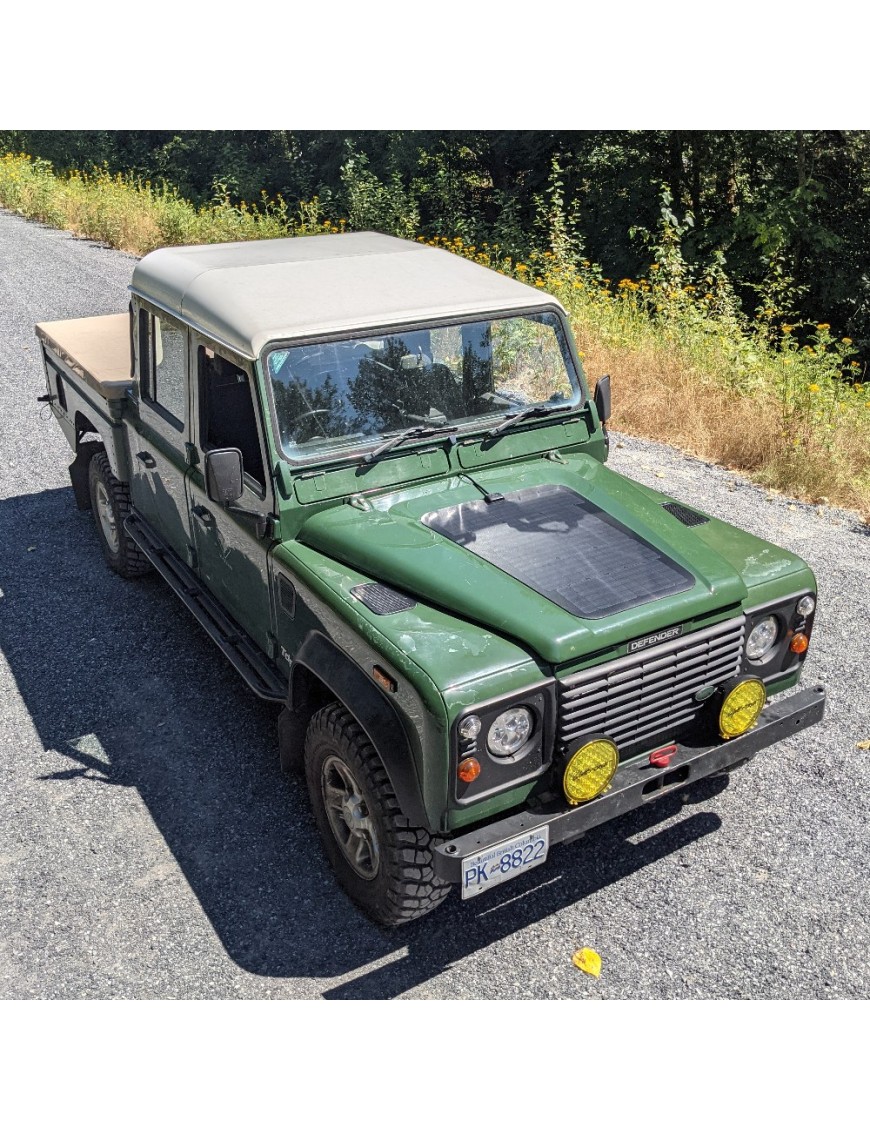
A complete Cascadia 4x4 bonnet solar system for the Land Rover Defender 1983-2006: a 75 W panel, a 10A MPPT charge controller and a custom-cut vinyl underlay that protects the paint. The manufacturer quotes installation from about 1.5 hours.
Cascadia 4x4 VSS System™ 1.0 CHF134CV — 75 W Complete Hood Solar Kit, Land Rover Defender 1983–2006
A hood panel with a Mopar catalogue number. Not because someone wrote so in a description, but because Cascadia 4x4 solar systems sit in the Affiliated Accessories catalogue under their own numbers. Details below.
The Defender has a flat, square bonnet that looks designed for a solar panel. Cascadia built a complete kit for exactly that: a 75 W panel, a 10A charge controller and a custom-cut vinyl underlay so the paint stays untouched.
Part number
CHF134CV
Power
75 W
Vehicle
Land Rover Defender 1983-2006
Key benefits
A complete kit, not just a panel — the 10A MPPT charge controller and a custom-cut vinyl underlay are included
Vinyl underlay protects the paint — the panel never touches the bonnet directly
Multilayered semi-flexible panel — shaped for the Defender bonnet
Power without starting the engine — fridge, chargers, lights and an inverter run off a battery topped up through the day
Plug-and-play installation — the manufacturer quotes installation from about 1.5 hours
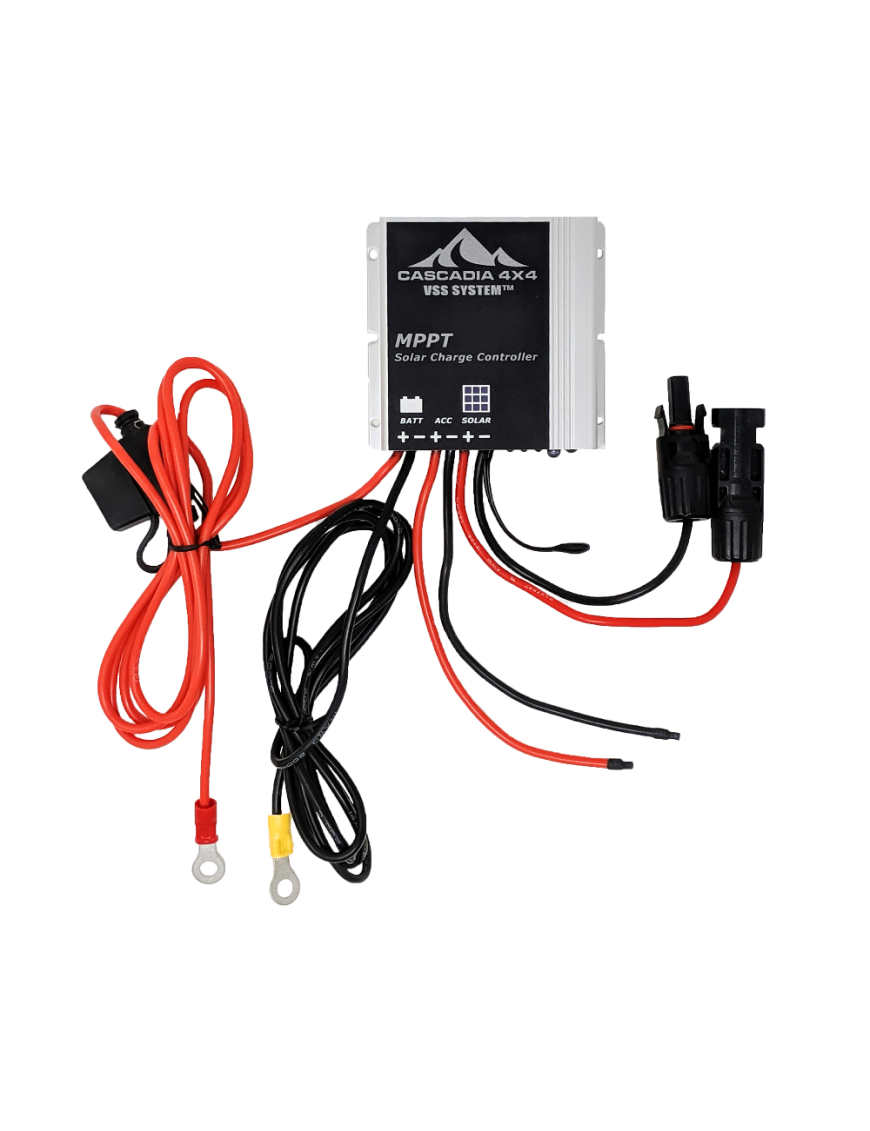
The 10A MPPT charge controller included in the kit
What is included
75 W hood solar panel for the Defender
10A MPPT charge controller
custom-cut protective vinyl underlay
Technical data
Part number: CHF134CV
Power: 75 W
Vehicle: Land Rover Defender 1983-2006
System generation: VSS System™ 1.0
Installation time per manufacturer: from about 1.5 hours
Who it is for
For expedition and working Defenders where the battery runs a fridge, lights or an inverter, and the vehicle can sit for days without moving.
Fitting and notes
The kit is cut for the Defender bonnet and the manufacturer quotes installation from about 1.5 hours.
Mopar catalogue numbers
There is a simple way to tell whether a hood solar panel is a serious product or a sheet from a wholesaler: check whether it has a catalogue number. Cascadia 4x4 solar systems have their own Mopar catalogue numbers, in the Affiliated Accessories category — the same catalogue you order parts for your Jeep from.
Mopar number
Vehicle
Wattage per Mopar
Model years
68678826AA
Jeep Wrangler (JL), Jeep Gladiator standard hood
85 W
2018–2026
68678827AA
Jeep Wrangler (JL), Jeep Gladiator Rubicon and Mojave hood
30 W
2018–2025
68678825AA
Jeep Wrangler (JK) standard hood
100 W
2008–2018
68678829AA
Ram 2500–3500
85 W
2010–2025
The wattages above are quoted exactly as the Mopar catalogue states them. The current Cascadia datasheet for this panel may state a different figure — the technical data for this particular product is in the section below.
To be clear: this is not a part manufactured by Mopar and we do not sell it as a genuine Jeep part. It is an affiliated accessory — an independent brand whose product passed a review serious enough to earn its own number in the group catalogue. You get into a programme like that; you cannot buy your way in with advertising.
What separates this from a cheap panel
Behind the catalogue number sits the rest: monocrystalline cells from a German plant, systems assembled in Canada, a factory certified to ISO 9001, ISO 14001, ISO 45001 and SA8000, panels compliant with IEC 61215 and IEC 61730, CE marking and RoHS and REACH compliance. Every model has a datasheet with full electrical and mechanical specification.
Now check the same things on a cheaper alternative. Its maker's website will usually give you no catalogue number, no factory location and not a single certificate — it will give you a list of shipping warehouses.
Warranty: 2 years on the panel with the option to extend to 5 years, 5 years on the charge controller. Claims are handled in Poland — you are not shipping a panel across an ocean.
Frequently asked questions
Do I need to buy a charge controller separately?
No. This is a complete kit — the 10A MPPT charge controller is included.
Will the panel damage the bonnet paint?
A custom-cut vinyl underlay is included and separates the panel from the metal.
How long does installation take?
The manufacturer quotes from about 1.5 hours.
How does this differ from VSS System™ 2.0?
It is the earlier generation, VSS System™ 1.0. The 2.0 panels use SolarClasp™ mounting, Contiguous Cell™ technology and a Bluetooth controller.
Product attributes
MARKALand Rover
MODELDefender I 90-98
Defender II 98-07
Brand
GPSR
ManufacturerCascadia 4x4
Brand
We don't have any questions and answers for this product yet. Ask your question on the right and we'll get back to you as soon as possible.
Question about this product
We reply during business hours, usually the same day.
No customer reviews for the moment.
Sign in
to add a review.
Your review appreciation cannot be sent
Report comment
Are you sure that you want to report this comment?
Report sent
Your report has been submitted and will be considered by a moderator.
Your report cannot be sent
Review sent
Your comment has been submitted and will be available once approved by a moderator.



 Cascadia 4x4