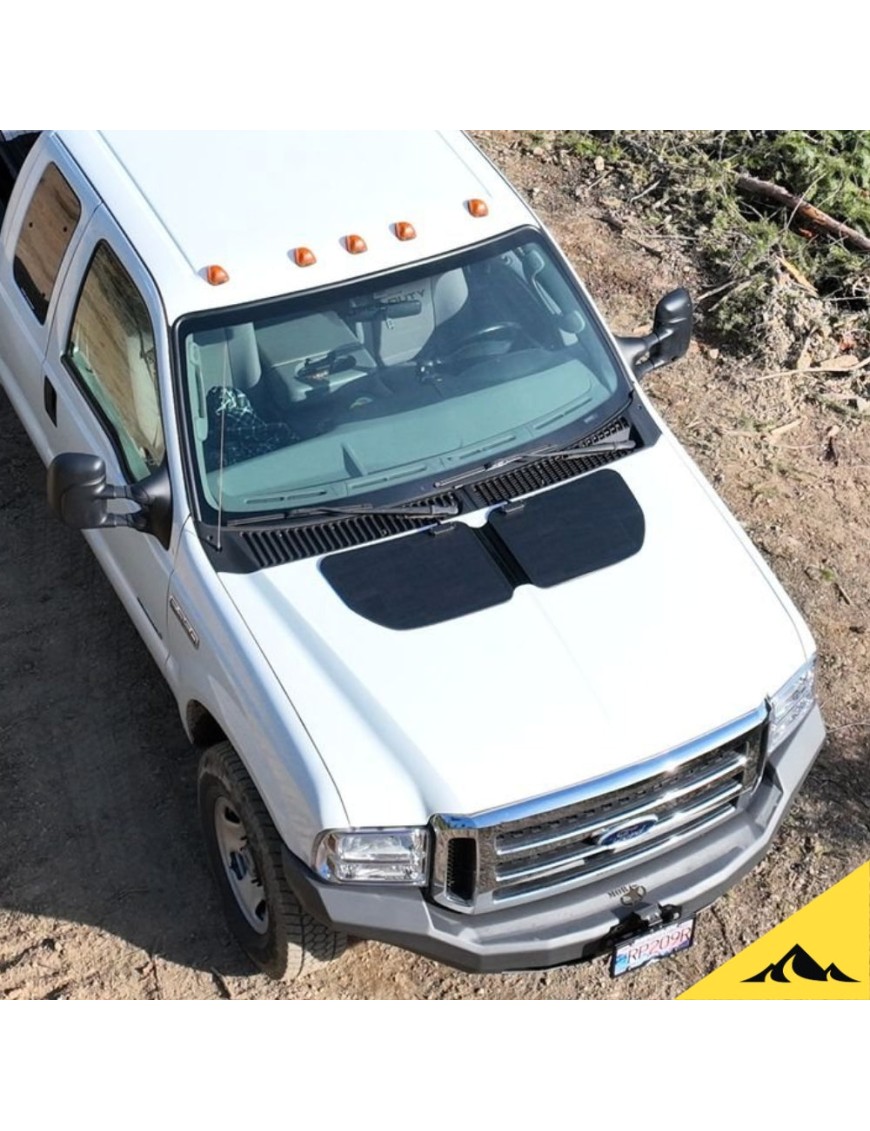
Cascadia 4x4 VSS System™ 2.0 hood solar panel for Ford Super Duty 1999-2007. SolarClasp™ mounting lets you remove the panel or move it to another vehicle, and the air gap underneath keeps it cooler. The battery charges while the vehicle sits. 2 year warranty, extendable to 5 years.
Cascadia 4x4 VSS System™ 2.0 CHF167 — Hood Solar Panel, Ford Super Duty 1999–2007
A hood panel with a Mopar catalogue number. Not because someone wrote so in a description, but because Cascadia 4x4 solar systems sit in the Affiliated Accessories catalogue under their own numbers. Details below.
An older Super Duty rarely has factory support for a second battery, yet it often carries more equipment than a new one. A hood panel gives it the steady charging source it never had from the factory.
Part number
CHF167
Vehicles
Ford Super Duty 1999-2007
Key benefits
Top-grade monocrystalline cells — 22.7–22.9 % efficiency — more watts from the same patch of hood
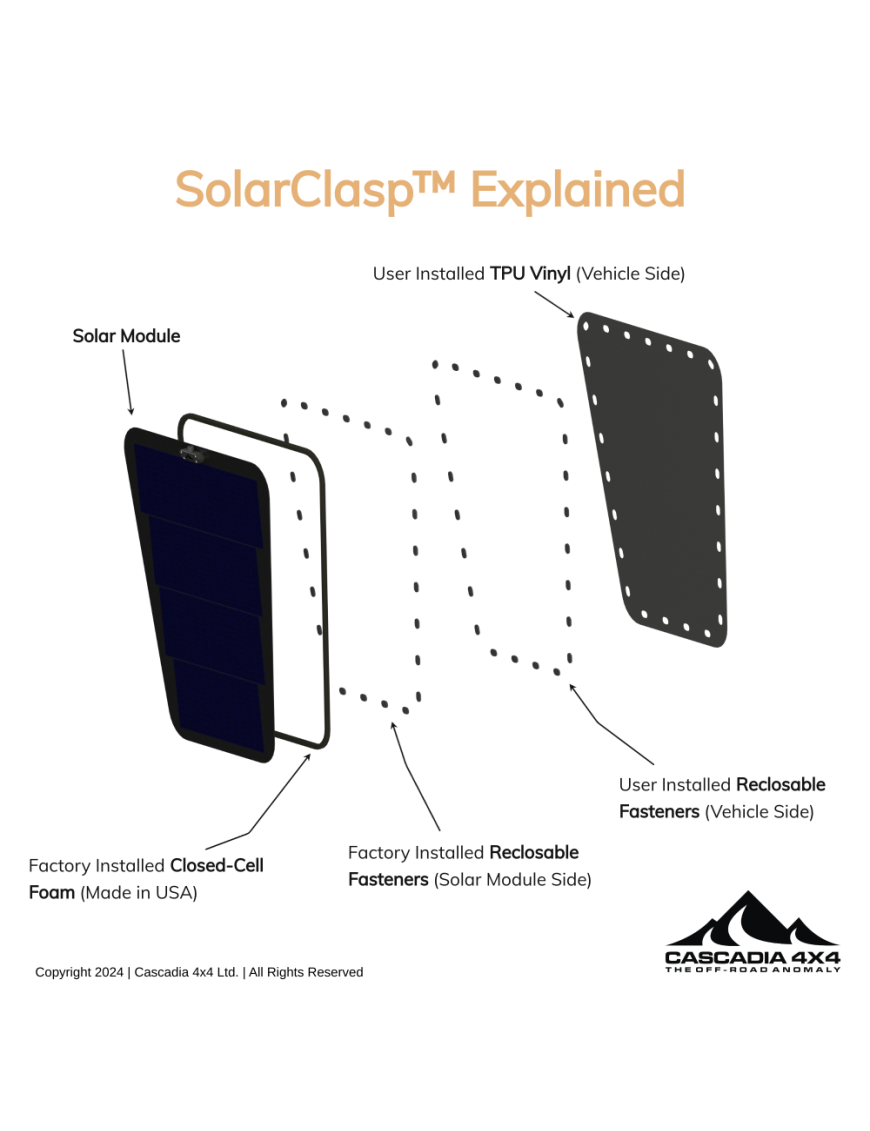
SolarClasp™ technology — the panel is held by reclosable fasteners and a closed-cell foam perimeter, so it can be removed, replaced or moved to another vehicle
Air gap under the panel — limits thermal bridging, so the panel runs cooler — and a cooler cell delivers more current
Contiguous Cell™ — cells bonded with conductive adhesive along their whole length instead of soldered busbars, removing the classic failure point of semi-flexible panels
Matte ETFE top sheet — no glass-like glare, self-cleaning, resistant to UV and chemicals
Impact, abrasion and cut-through resistance — this panel lives on a hood, within reach of gravel and branches
Flexible construction — conforms to the bodywork, no flat surface required
Impact-resistant junction box and MC4 connectors — standard PV connectors
Bluetooth monitoring — the CascadiaTether™ app shows how the system is working and lets you program it
What is included
solar module or modules
SolarClasp™ installation components
installation instructions
A solar charge controller is required and sold separately — for VSS System™ 2.0 panels the manufacturer pairs the 15A MPPT Bluetooth controller.
SolarClasp™ technology — panel mounting and the air gap
Technical data
Part number: CHF167
Vehicles: Ford Super Duty 1999-2007
Manufacturing: made in Canada with globally imported parts
Warranty: 2 years, extendable to 5 years
Who it is for
For owners of 1999–2007 Super Duty trucks used for work or travel who want the battery charged while the truck sits.
Fitting and notes
The panel mounts on the hood without drilling — you apply the vinyl and the vehicle-side half of the SolarClasp™ fasteners, the panel goes on top, and it can be removed or moved to another vehicle later.
Mopar catalogue numbers
There is a simple way to tell whether a hood solar panel is a serious product or a sheet from a wholesaler: check whether it has a catalogue number. Cascadia 4x4 solar systems have their own Mopar catalogue numbers, in the Affiliated Accessories category — the same catalogue you order parts for your Jeep from.
Mopar number
Vehicle
Wattage per Mopar
Model years
68678826AA
Jeep Wrangler (JL), Jeep Gladiator standard hood
85 W
2018–2026
68678827AA
Jeep Wrangler (JL), Jeep Gladiator Rubicon and Mojave hood
30 W
2018–2025
68678825AA
Jeep Wrangler (JK) standard hood
100 W
2008–2018
68678829AA
Ram 2500–3500
85 W
2010–2025
The wattages above are quoted exactly as the Mopar catalogue states them. The current Cascadia datasheet for this panel may state a different figure — the technical data for this particular product is in the section below.
To be clear: this is not a part manufactured by Mopar and we do not sell it as a genuine Jeep part. It is an affiliated accessory — an independent brand whose product passed a review serious enough to earn its own number in the group catalogue. You get into a programme like that; you cannot buy your way in with advertising.
What separates this from a cheap panel
Behind the catalogue number sits the rest: monocrystalline cells from a German plant, systems assembled in Canada, a factory certified to ISO 9001, ISO 14001, ISO 45001 and SA8000, panels compliant with IEC 61215 and IEC 61730, CE marking and RoHS and REACH compliance. Every model has a datasheet with full electrical and mechanical specification.
Now check the same things on a cheaper alternative. Its maker's website will usually give you no catalogue number, no factory location and not a single certificate — it will give you a list of shipping warehouses.
Warranty: 2 years on the panel with the option to extend to 5 years, 5 years on the charge controller. Claims are handled in Poland — you are not shipping a panel across an ocean.
Frequently asked questions
Does the panel need a charge controller?
Yes. The manufacturer lists a solar charge controller as required — VSS System™ 2.0 panels are paired with the 15A MPPT Bluetooth controller, sold separately.
Can the panel be removed or moved to another vehicle?
Yes, that is the point of SolarClasp™. The panel is held by reclosable fasteners and a foam perimeter, so it can be removed, replaced or transferred.
Does fitting require drilling the hood?
No. You apply the vinyl and the vehicle-side fasteners, and the panel goes on top.
What is the warranty?
The manufacturer states 2 years from the date of purchase, extendable to 5 years.
Product attributes
MARKAFord
MODELFord F-250 Super Duty 4WD 1999-2004
Brand
GPSR
ManufacturerCascadia 4x4
Brand
We don't have any questions and answers for this product yet. Ask your question on the right and we'll get back to you as soon as possible.
Question about this product
We reply during business hours, usually the same day.
No customer reviews for the moment.
Sign in
to add a review.
Your review appreciation cannot be sent
Report comment
Are you sure that you want to report this comment?
Report sent
Your report has been submitted and will be considered by a moderator.
Your report cannot be sent
Review sent
Your comment has been submitted and will be available once approved by a moderator.



 Cascadia 4x4